
Through turbid waters - Dr Cait Newport is discovering how fish find their way
07 April 2026
Dr Cait Newport’s work looks at the humble fish – underappreciated and overlooked, but with much more intelligence than you might think. By using AI to analyse how fish make decisions, Cait’s research doesn’t just help us understand how fish might respond to change, but could even transform AI itself by improving how autonomous systems function.
It took Cait a while to realise she wanted to be a scientist; growing up, she did not have any clear examples about what a scientist does, beyond memorising facts and solving equations. It wasn’t until her final year of her undergraduate degree that she realised it was more than that: “It is actually an incredibly creative job. You are constantly learning, finding new ways to test ideas, and adapting when things don’t work the first time. Once I understood what I was supposed to be doing, I loved it.”
Cait was drawn to working with fish because they defy our expectations and force us to rethink what ‘intelligence’ can look like. She explains that when you observe fish underwater, you realise they are far more complex and interesting than popular culture suggests – they have social dynamics, distinct personalities, and change their behaviour based on experience, just like we do. “There are still big questions in my field about how they achieve this despite relatively simpler brains, why these cognitive abilities are useful, and how global challenges like environmental change will affect their behaviour and survival”, Cait says. “I am particularly excited to understand how fish use their intelligence to solve problems, and whether their cognitive systems are flexible enough to cope with the environmental challenges on the horizon.”
Cait uses AI to analyse video data of fish swimming on coral reefs. When she first embarked on this journey, AI and neural networks weren’t as accessible to non-experts, so she relied on classical computer vision techniques. Whilst some tasks consistently failed, the process helped her understand what made her data challenging. Once AI methods became more accessible, she was able to solve many of her problems; because she understood the limitations of classical approaches, she was in a better position to choose and apply the appropriate AI tools to her research.
The biggest challenge wasn’t the AI models themselves, but the surrounding infrastructure. She transitioned from R and MATLAB to Python, learnt how to use GPUs effectively, understand memory constraints, and became comfortable working with Linux, on computer clusters, and with GitHub. Cait notes that it was sometimes hard to see how all these pieces fit together, and what made the process more manageable was being part of a cohort of other Schmidt Fellows: “I could essentially crowdsource knowledge from other’s experience and expertise. My advice would be to find a community of people who can help answer questions you didn’t even know to ask.”
AI has completely changed Cait’s research trajectory: “Using AI didn’t just give me new analytical tools, it genuinely reshaped parts of my experimental approach – learning about reinforcement learning and agent-based modelling wasn’t part of my original plan, but it fundamentally changed how I thought about animal behaviour”. The frameworks gave Cait a new way to design experiments and helped her develop novel approaches to her follow-on work, which ultimately formed the basis of her senior research fellowship application.
Cait has been awarded a Royal Society University Research Fellowship which she will start in June. Her goal is to turn animal behaviour into algorithms that can be applied to autonomous navigation systems.
Looking ahead, Cait is excited about uncovering the range of animal intelligence and exploring how those insights can be applied to technology. A particularly exciting question for Cait is what we can learn from animals about how to make decisions in challenging situations where information is incomplete or conflicting. Understanding these processes helps us understand the evolution of brain systems and predict how animals might respond to changing environmental conditions. She is also interested in turning these biological principles into lightweight and efficient decision-making algorithms that can be used in robotic systems.
The scope of Cait’s work is broad and fascinating. As Cait puts it, “Training fish and being able to communicate what they are meant to do – and then watch them successfully do it – is incredible and never gets old.”
Using AI didn’t just give me new analytical tools, it genuinely reshaped parts of my experimental approach
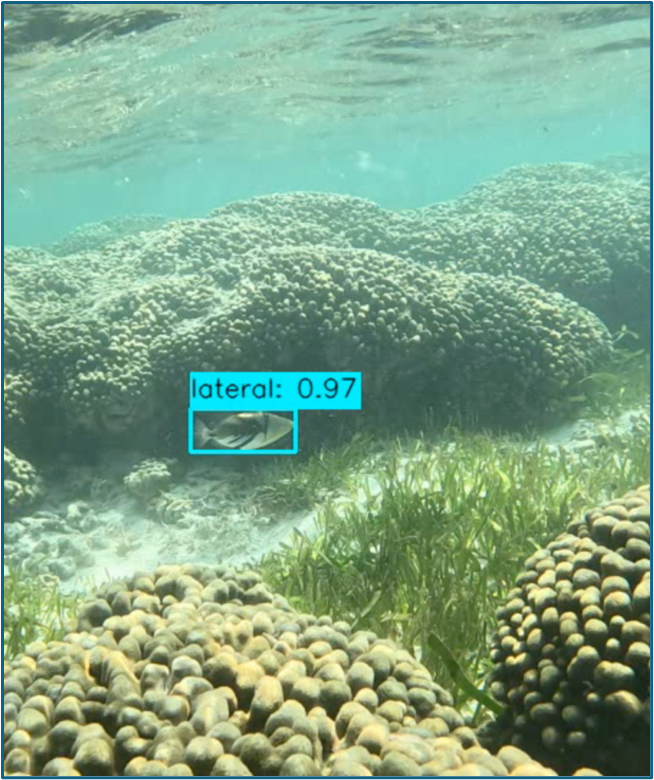
Video frame showing detection and pose classification of a Picasso triggerfish
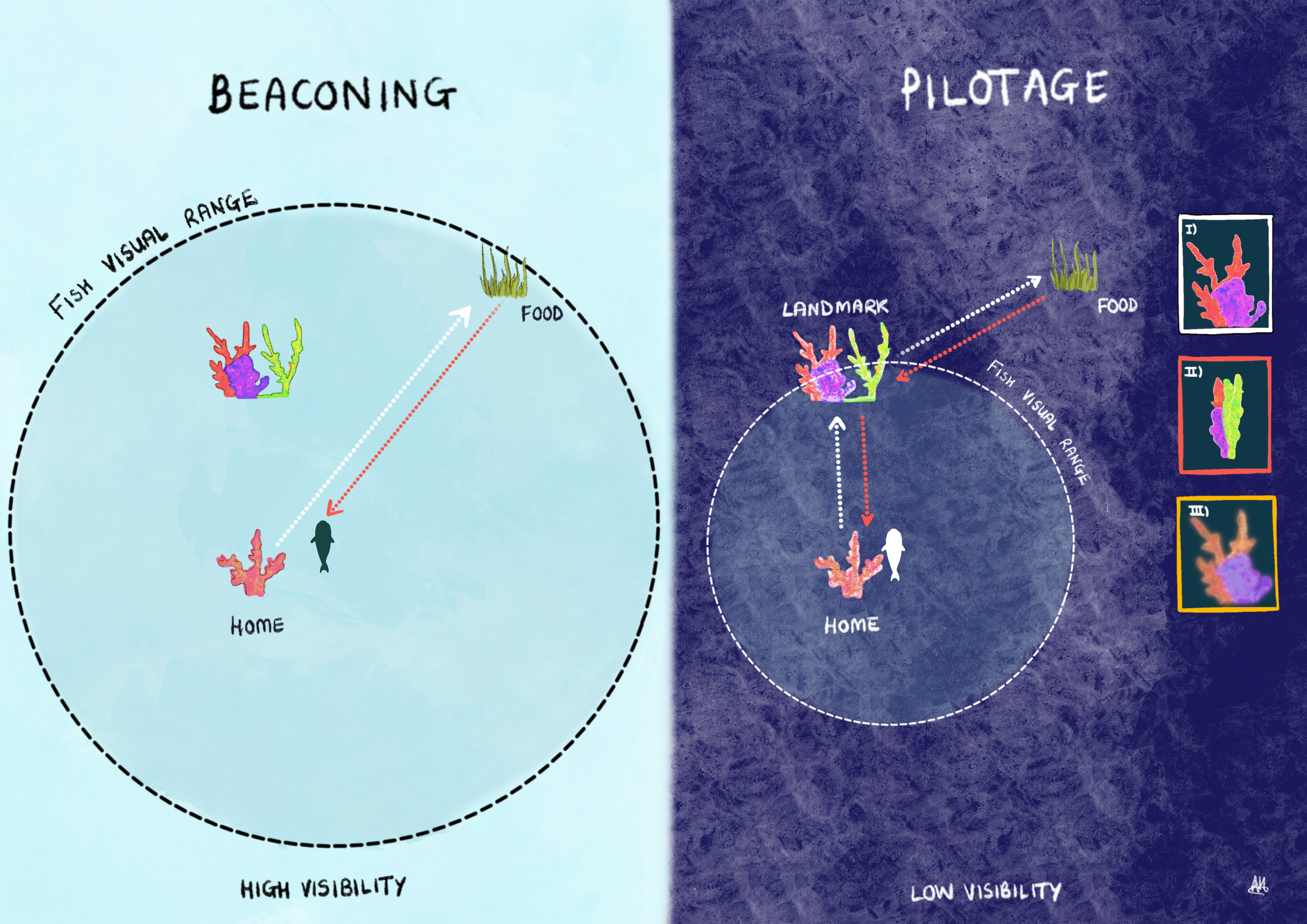
An illustration of how fish find food at different levels of visibility. At high visibility, food may be in visual range, but in low visibility they may need to use a landmark that helps them navigate (Credit: Alicia Hayden)